

Piano Man holds up 100-year old places
On that place where Billy Joel wrote Piano Man.


“Son, can you play me a memory?”
Hi, everyone-
Today: something gritty yet warm for your insides. I am sharing with you a time-lapse rewind of where Billy Joel’s iconic Piano Man song was written: the Executive Room in California. Specifically, the three periods of the place:
First: the Executive Room (yes, where Joel wrote Piano Man in 1973),
Then, what it was before: Ham & Eggs restaurant in 1937 (yes, I was surprised, too)
Now: A Pollo Loco restaurant, aka Crazy Chicken in Spanish (yes, I thought the same: What’s with all the chicken theme?).
Last week, I talked about the heated quality of memories in the Dead Sea. And Piano Man is no less about memory, as it is about people and places. And how they heat—no, fire—each other up. After all, Joel asks us:
“Son, can you play me a memory?”
But I also want another perspective for this piece. That of a piano woman. So I had a conversation with our friend Julie Gabrielli who, turns out, also played the piano in a college bar. Julie Gabrielli’s work as a writer, architect, and professor navigates our time of climate collapse and environmental reconciliation. She writes the Homecoming newsletter on Substack, and her work has been published in the magazines Orion, Ecological Home Ideas, and Urbanite; and in literary journals: Dark Mountain Journal #6, #8 and #10; Dark Matter #3 and Immanence. Her essay, “Song of the Chesapeake,” is included in the 2025 anthology, Dark Matter: Women Witnessing: Dreams Before Extinction.
You’ll hear her personal take as I share my findings on the place where Piano Man was written.
I had so much fun getting to use all my professional training in this one. Mapping the geography of the city. Digging into its architectural history. Putting a magnifying glass on the Executive Room. And most of all: hearing Julie’s wonderful perspective.
It’s such a treat.
I hope you enjoy this one as much as I do!
Warmly,
-Thalia
1
1973: The Executive Room
First, let me share with you this interview that Billy Joel himself did with the Library of Congress on April 12, 2017.
LOC: After “Piano Man” became a hit, did you ever hear again from any of the people …?
BJ: Well, the waitress, obviously. She got a piece of me [Laughs]. But that was it. I never heard from any of them … The name of that bar was The Executive Room. It was in the Wilshire District in Los Angeles. It’s no longer there.
This is the place Billy Joel was talking about.
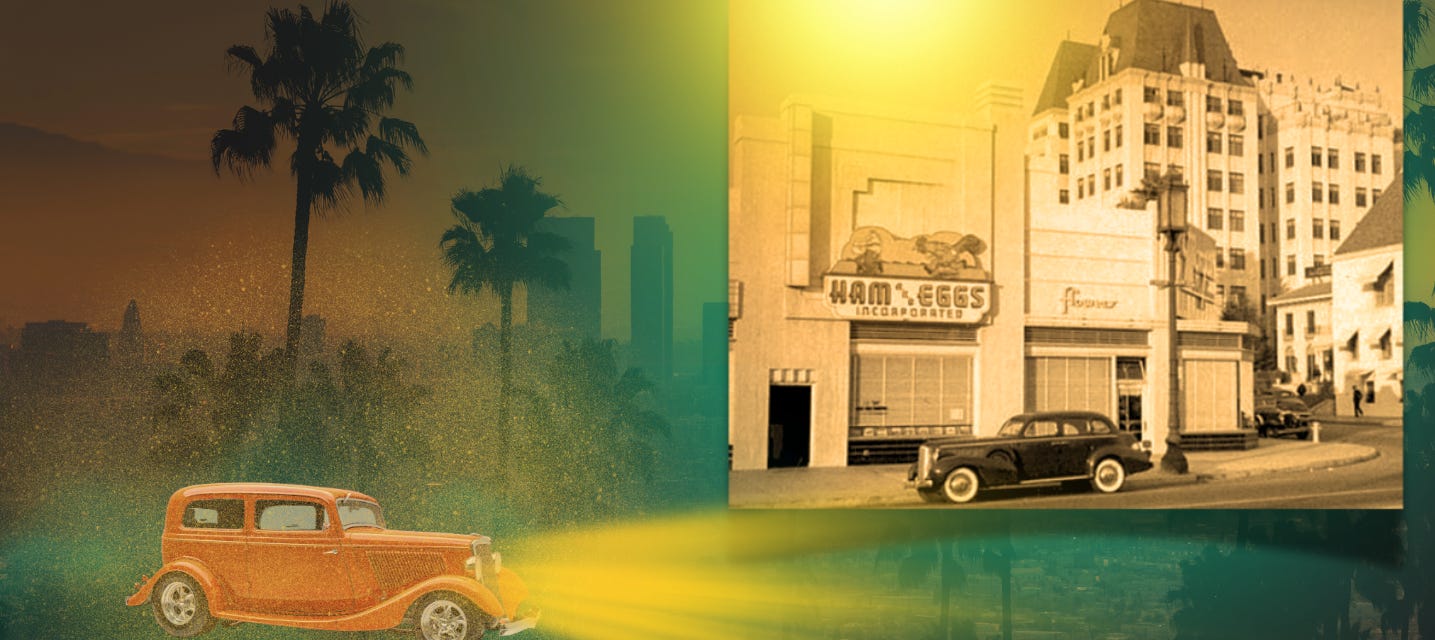
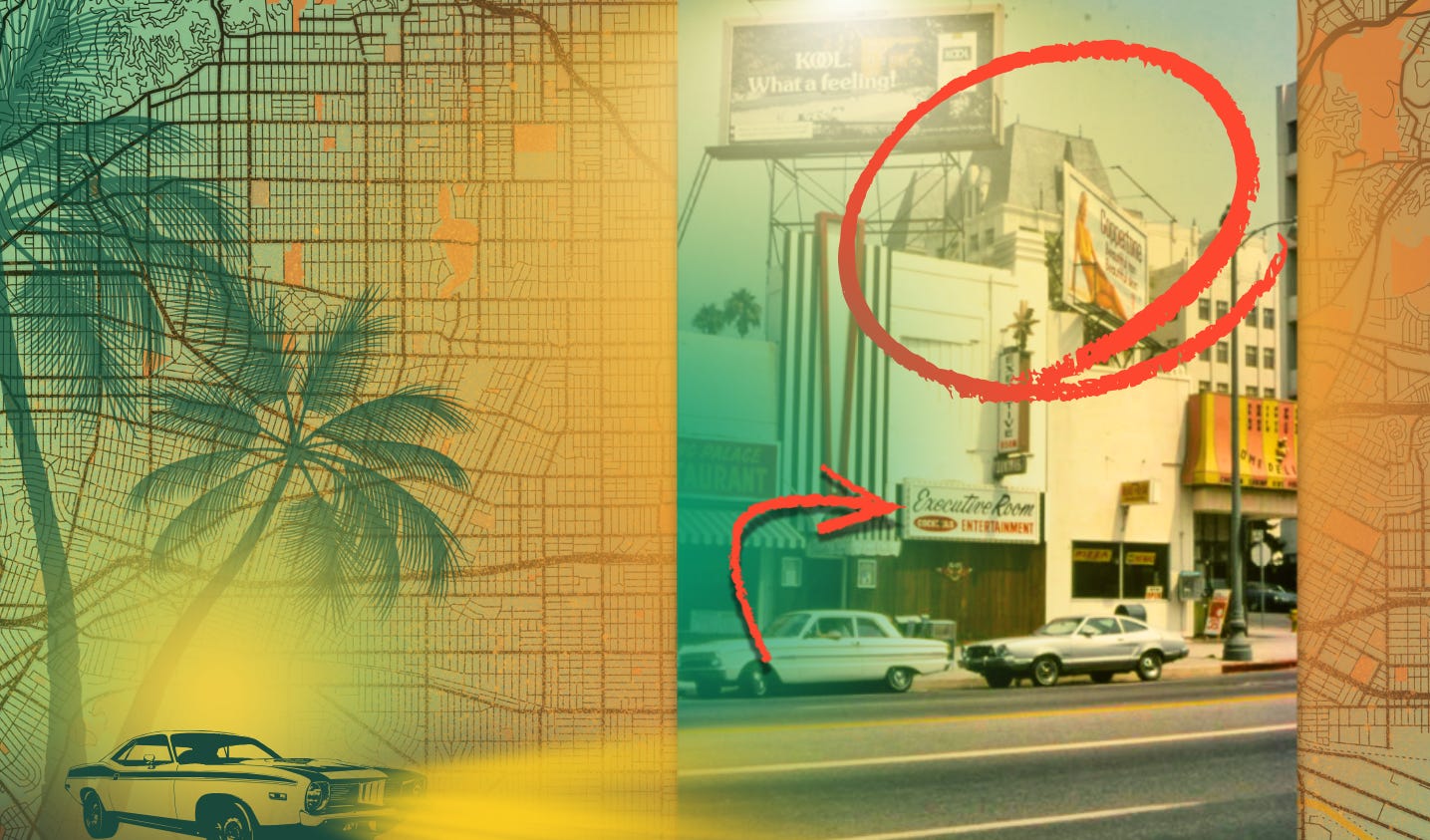
The funny thing about the Executive Room is that the name is nothing at all what the words meant. Most executive rooms I know of are for vast hotel rooms meant for rock stars to do some real damage. But that’s not at all what I imagined when I learned about the Executive Room. Least of all after Piano Man’s lyrics (and atmosphere) are now too far embedded in my psyche.
I’m thinking a ‘real estate novelist,’ is simply a completely different person—from a real estate executive.
Here’s Julie’s take on the lyrics.
Julie: I admire the poetry of lines like “the waitress is practicing politics”—I mean, what a brilliant feminist detail. And I can’t listen to the passage about the bartender without my heart breaking a little. The place is killing him, his life is slipping by, and he’ll never be a movie star. Ouch.
I imagine a failed concert pianist, or someone with an abundance of talent but no money for music school. Or maybe he’s perfectly content to be there, lifting their spirits and his own with the music.
Quite a difference from the common associations of the word ‘executive.’ Of course, Billy Joel wasn’t there to execute anything much more beyond musical pieces. If anything, he was there just to exude back whatever the place and the people have exuded to him. Much as the present builds upon what was the past. To Julie’s great point, I think there’s poetic justice in contrasting the long-held persona of an executive with an Executive Room’s very non-executive yet ever presently relatable characters.
Sort of a temporal fight between the past and present. In which humanity—wins with timelessness.
But how exactly is the song that timeless?
Julie: As for the narration, I’d say the song is timeless because we’ve all been there. We’ve all been lonely, nostalgic, or regretful about life choices. Many of us have been to bars like that—dark, smoky, depressing, full of people in need of rescue seeking alcohol’s false cheer. All that pretending cloaked in smoke and poor lighting.
Which brings me to 1973 Executive Room’s past—in 1937.
2
1937: Ham & Eggs restaurant
Before we go on, let me just share with you who might be new here, that: Thalia is a nerd. I’d notice things like how the year ‘37 is a direct inverse of ‘73. While other people might ignore this.
Because: Thalia, so what?
Well, Billy Joel cared for this. He cared for contrasts. Comparisons. And even opposites. He cared enough to say ‘real estate novelist’ instead of ‘real estate executive.’ Piano Man cared enough to paint a picture of a smoke-filled room. A place of broken adults. A place very far from the smiley, old-timey, and family-friendly image people prefer to remember. A place where decades ago once stood: a Ham & Eggs restaurant—indeed a family-friendly place.
Here’s a picture of their logo on matchbook covers they’d hand out to people, most of whom still smoked cigarettes back then. Some of you might still remember what this is for. The palm-sized flip-up paper envelope where about a dozen matches line in a row.
Waiting for us to open. Rip. And let fire … rip.
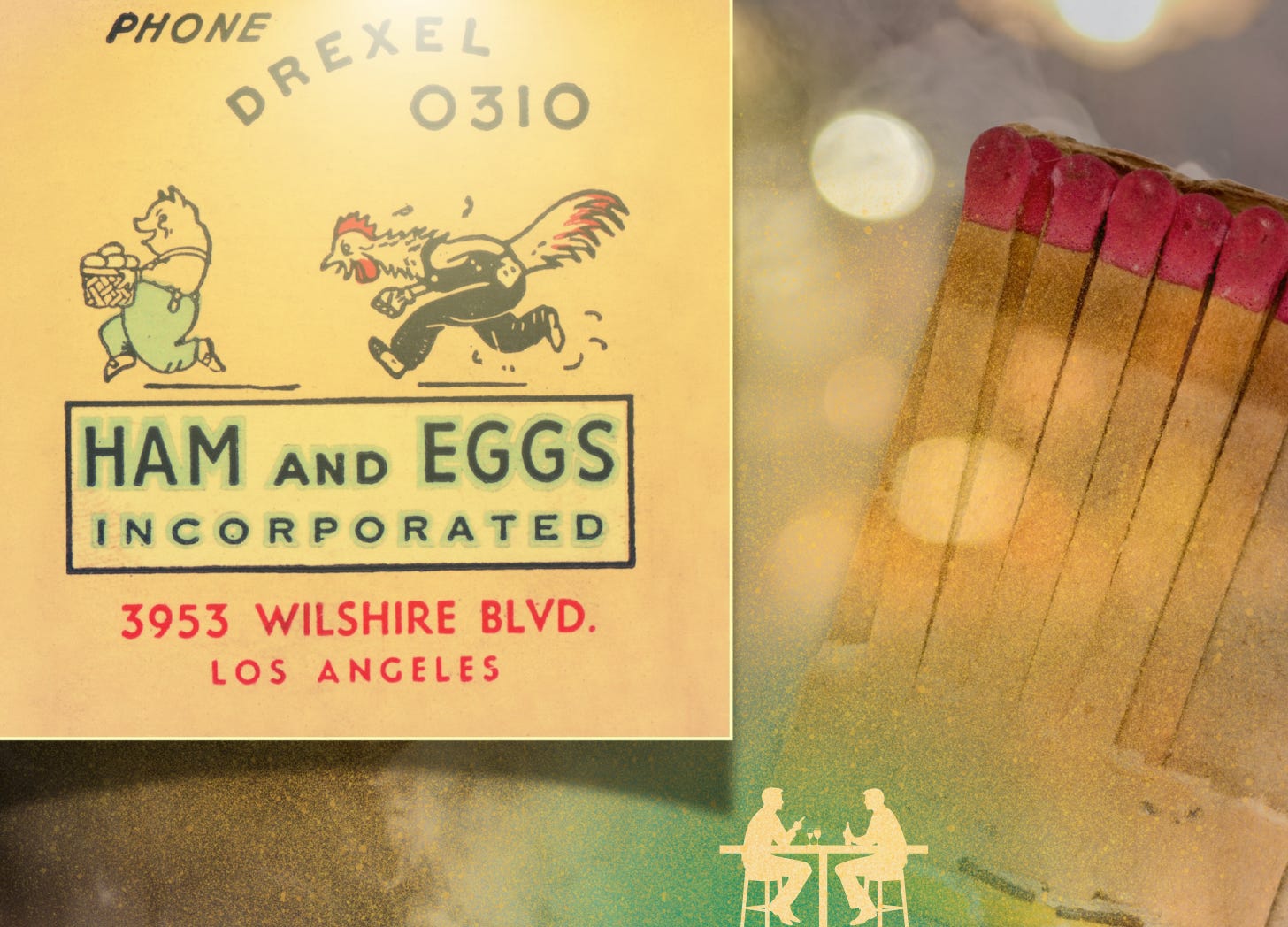
It’s been a minute since I’ve gone to a bar. And I can’t remember ever really figuring out what it must’ve been like to work there. As a bartender. A waiter. Or a piano man. So I wanted to recount how it’s like again. By asking Julie what her experience was like playing gigs in a bar many moons ago.
After all:
“Son, can you play me a memory?”
Julie: Eventually … I graduated to bartender, which was terrific fun, and then waiter, which was the best ever. The other waiters were real pros: this was their actual job. It was a pretty swank restaurant, and I enjoyed the theatrical feel of approaching a table to curate their evening. My first outing is painfully etched in memory because the patron ordered Steak Tartare and I asked him how he’d like it cooked. Yes, I really did that.
We waiters had a household toaster oven at our station for heating up excellent bread for the tables. I was obsessive about doing it just right, neither under-, nor overdone. Years later, when I went back to see my old pals, they told me they still called it “Julie bread.” What an honor.
Here’s the thing about memory. It recalls—no, chooses—worthy details. The fact that Julie’s friends named the toaster-oven style bread after her, is pretty much a song on a memory loop. Each time the oven heats up, the piano man—I mean ‘waiter’—plays this memory of Julie’s intent. On getting the bread just right.
By the way, I don’t eat bread, play the piano, or even drink much. But I’ve always believed that food (like bread), songs (like Piano Man), and drinks (like ones from the bar) are all memory imprints. A materialized form of whatever would’ve otherwise floated (and got lost) within people’s genius. My friends would always ask:
Thalia, what’s with your obsession with places anyhow?
The memory imprint concept would be my explanation for this question. I think Billy Joel might’ve sensed this, too, when he called drink ‘loneliness.’
Julie: I’ve always pictured a dim, smoky place, where the corner booths are hidden behind a veil of gloom. Pools of weak light illuminate down-and-out drinkers, most of them alone with their thoughts and empties. A few sit together, like the businessmen slowly getting stoned. But even they are “sharing a drink they call loneliness.”
… Piano Man has a soul patch and a vast repertoire; he doesn’t need one of those fake-books. He’s just up there playing whatever he feels like until he gets a specific request. He always plays requests, because those are the biggest tippers. He wasn’t a smoker when he started. But there’s so much second-hand smoke in the room, he might as well join them. At least his smokes are filtered and he likes the kick.
Helps him stay awake till closing time.
Closing time …
When would that be, do you guys think?
We don’t always get to choose when our closing time might be. For Ham & Eggs restaurant, its closing is the eventual opening for the Executive Room. And for the Executive Room, its closing time is the eventual opening of El Pollo Loco. The time when it clocks—no, clucks—in.
3
El Pollo Loco Restaurant
Spanish for Crazy Chicken, the name says it all. The setting for this restaurant is no-fuss. But imagine yourself in that getaway place somewhere warm. Where the music is on a loop. Where the waiter’s sun-kissed skin—makes your eyes hurt and heal at the same time. And where old Los Angeles was that place.
A place where dreams sound like a chord progression.
You’ll see why: the place isn’t so ‘loco’ to be El Pollo Loco. From Ham & Eggs, to the Executive Room, to El Pollo Loco. Now my question is: what’s next?
4
2037: What next?
I can bore you with an executive summary on city zoning and urban planning directions. Julie can, too.
But a lot of these things are driven by the young’s appetite.
Be it for food (chicken, eggs or otherwise).
Or for music (Executive Room or co-working space for travel nomads).
Or even for offices (the way things are going, up and coming AI-forward ventures).
But ultimately it depends on the city of Los Angeles. And what kind of youth they’re breeding. In the 1970s, the ‘cool’ youths like Joel, were musicians. Pianists. And artists. The youths now might also be artisanal. But the tools have changed. And it’s up to the incoming young adults to decide.
If it’s any indication, I’d imagine that students—like young Julie—busking as piano players might determine much of what will happen next to the place. And I’m OK with it. Even if it might not be a bar with piano as we knew it.
Julie: In my second year of undergrad to support my record-buying habit, I answered an ad in the paper for a piano player at a local restaurant called, not making this up, The Gaslight. I was all of 18 years old and the drinking age had recently been raised to 21. Yes, the piano was literally built into the bar. It was a Wurlitzer, a name I recognized because they made pipe organs like the one in Radio City Music Hall. Their theater organs accompanied silent movies and they also made gorgeous, elaborate jukeboxes and player pianos, both of which have always fascinated me.
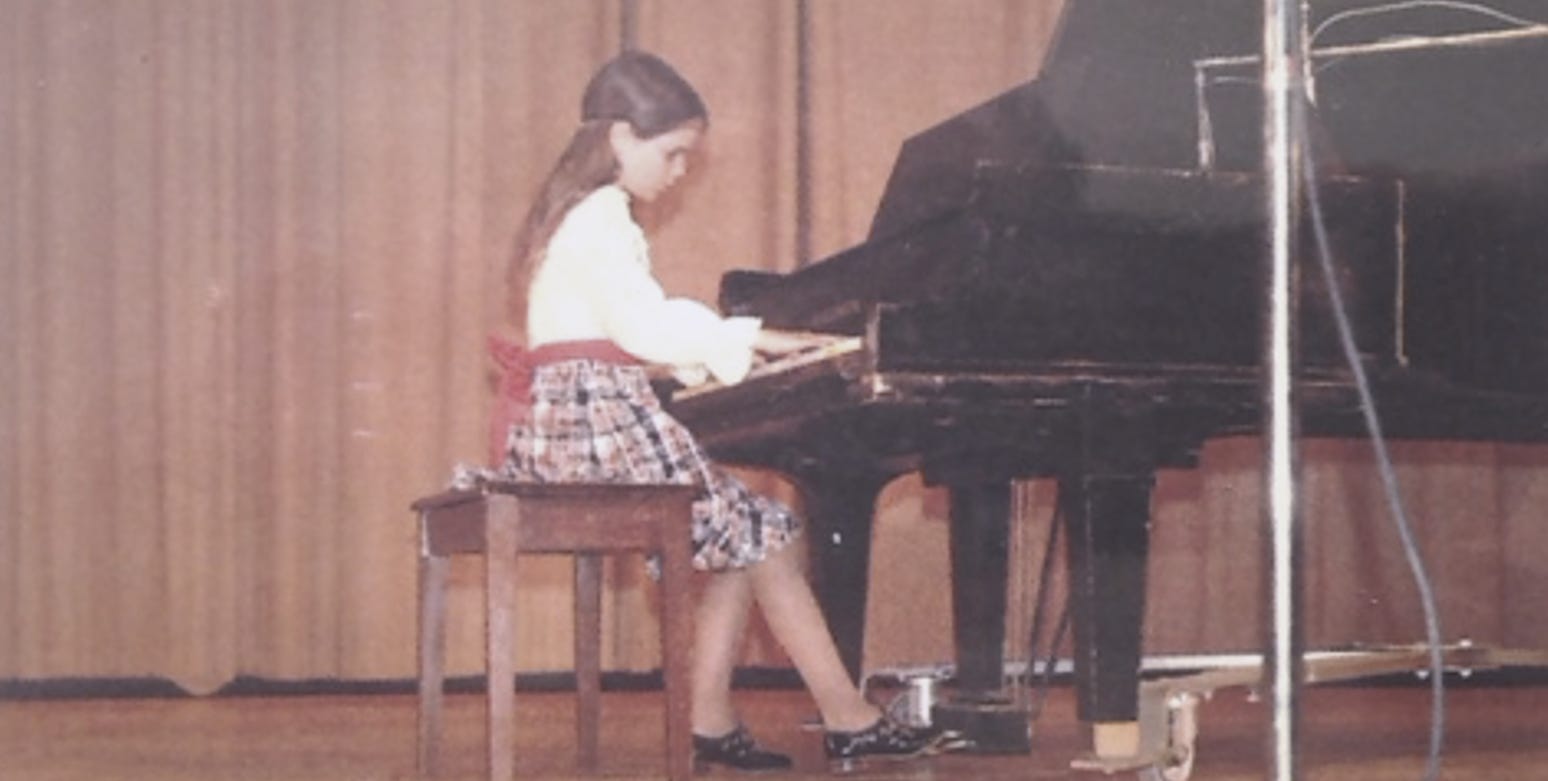
But what about you?
What do you think the space should be by 2037?
A mini Radio City Music Hall? Another ham & eggs food? Another type of a bar?
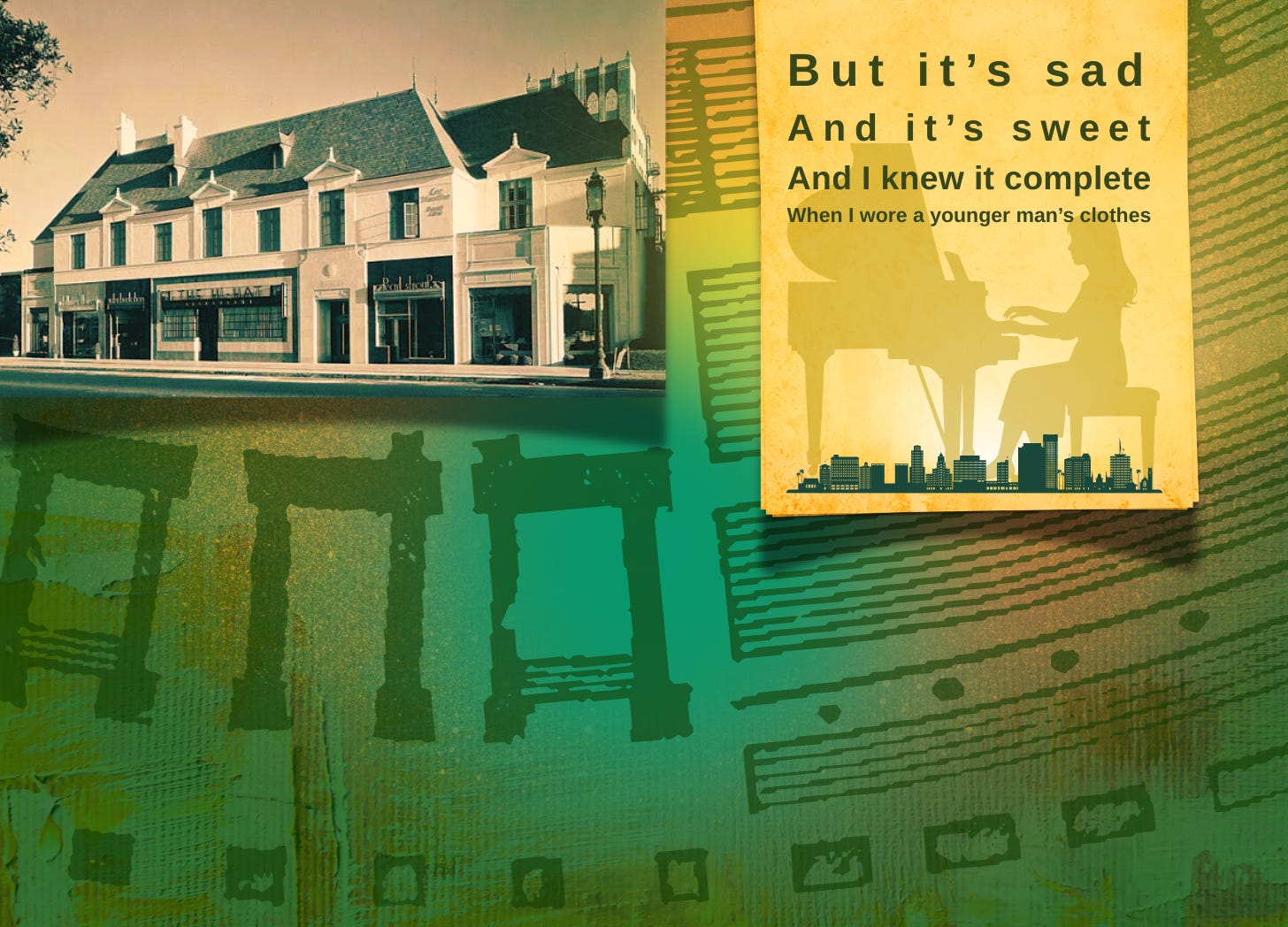
My vote is for the place to be something that can ideally echo forth, these words—forever:
“Son, can you play me a memory?”
Sing us a song, you’re the piano man
Sing us a song tonight
Well, we’re all in the mood for a melody
And you’ve got us feelin’ alright
That’s right.
Sing us a song.
You’re the piano man.
-Thalia
PS
If you’re a paying subscriber, look for a BONUS piece in your inbox this week:

Billy Joel’s Places: A Ride of a Lifetime
This one will be about other places that impacted Billy Joel’s life. Including:
What the street in his hometown Hicksville New York would’ve looked like in 1964.
On where Billy Joel and his dog Whitey loved to hang out.
On the curious use where his cover photo for his album The Stranger was shot.
Billy Joel’s 52nd Street album vs. the real 52nd Street.
On where New York State of Mind was written: the historic 26-acre waterfront estate.
As always, it’s been a privilege serving you. Because ‘you’ve got us feeling alright.’
Warmly,
-Thalia
 | A guest post by
|